Welcome to the Center for Wildlife Health at the University of Tennessee
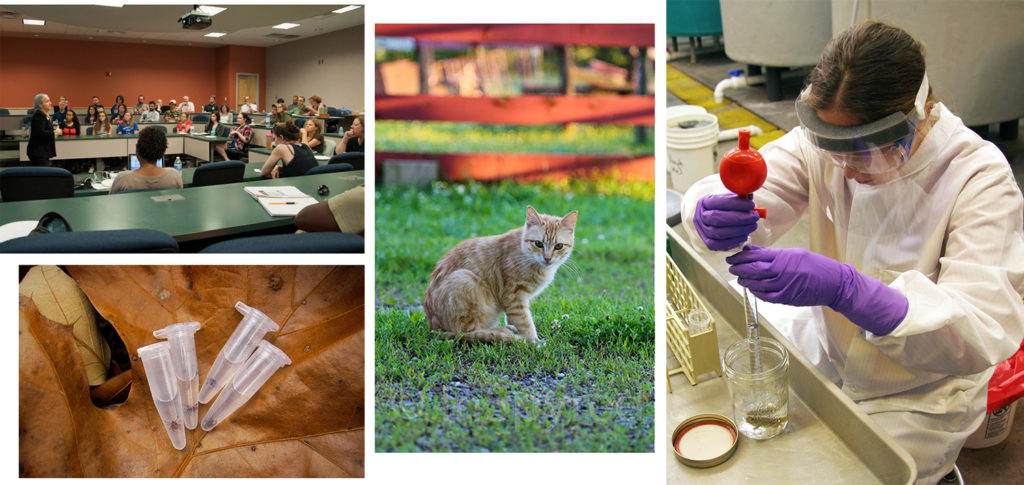
The Center for Wildlife Health is located within the Department of Forestry, Wildlife and Fisheries in the Institute of Agriculture at the University of Tennessee Knoxville. The Center provides a multidisciplinary environment for the study of health issues arising from the interaction of wildlife, livestock, humans and the environment. The Center contributes at both the regional and international level through seminars, taught courses, research and public outreach.
Wildlife Health research, and the related field of Conservation Medicine, are academic areas that are growing rapidly in importance. This growth is being driven in part by concern about zoonotic diseases — cross-species diseases that travel to humans from other animals — such as rabies, Lyme disease, Severe Acute Respiratory Syndrome (SARS), avian influenza, West Nile virus, and other emerging infectious diseases. Similarly, diseases such as bovine tuberculosis and brucellosis travel from wildlife to livestock and thereby threaten our agricultural production systems. Furthermore, diseases such as chronic wasting disease (CWD) in deer and elk, and chytridiomycosis in amphibians, are examples of growing health threats to valued wildlife populations themselves.
Such issues require not only fundamental research into wildlife disease ecology and diagnosis, but also application of research findings in ways that provide practical assistance for resource managers and policy-makers. These problems must be addressed using a team approach that involves wildlife biologists, entomologists, veterinarians, animal production managers, public health specialists, epidemiologists and numerous other disciplines. A key objective of the Center for Wildlife Health is to assist these specialists working closely together, both on the UT campus and through off-campus collaboration. |